How DiSC Helps to Unlock Motivation at Work
If you ask a room full of managers what motivates people, you’ll likely hear familiar answers: recognition, rewards, career growth, meaningful work. And while those factors certainly matter, they don’t explain why one employee is energized by public praise while another cringes under the spotlight. Or why one thrives in fast-paced experimentation while another wants time, structure, and clarity before taking action.
The truth is simple:
People are motivated in very different ways — and DiSC® gives leaders a practical roadmap for understanding those differences.
Each DiSC style has distinct drivers, fears, and psychological needs. When leaders understand these nuances, they stop guessing and start managing in a way that creates real engagement.
This is increasingly relevant in organizations dealing with burnout, constant change, and a more diverse workforce than ever before.
Let’s explore what truly motivates each DiSC style — and, equally important, what demotivates them — using the posters and the Psychological Needs model as a guide.
The Psychology Behind Motivation: Understanding What People Need to Thrive

Before diving into each style, it’s helpful to look at the broader map of human needs.
The Psychological Needs chart shows the core drivers that sit underneath DiSC behavior:
-
D-styles lean toward autonomy, challenge, progress, and maintaining control.
-
i-styles seek expression, social connection, optimism, and feeling “in” with the group.
-
S-styles prioritize harmony, familiarity, reassurance, and stability.
-
C-styles value precision, standards, competence, and predictability.
These needs shape the motivational triggers we see in each style — and also explain why certain environments create stress, disengagement, or withdrawal.
Let’s take a closer look.
Motivation by DiSC Style
 D-Style Motivation: Achievement, Impact, and Autonomy
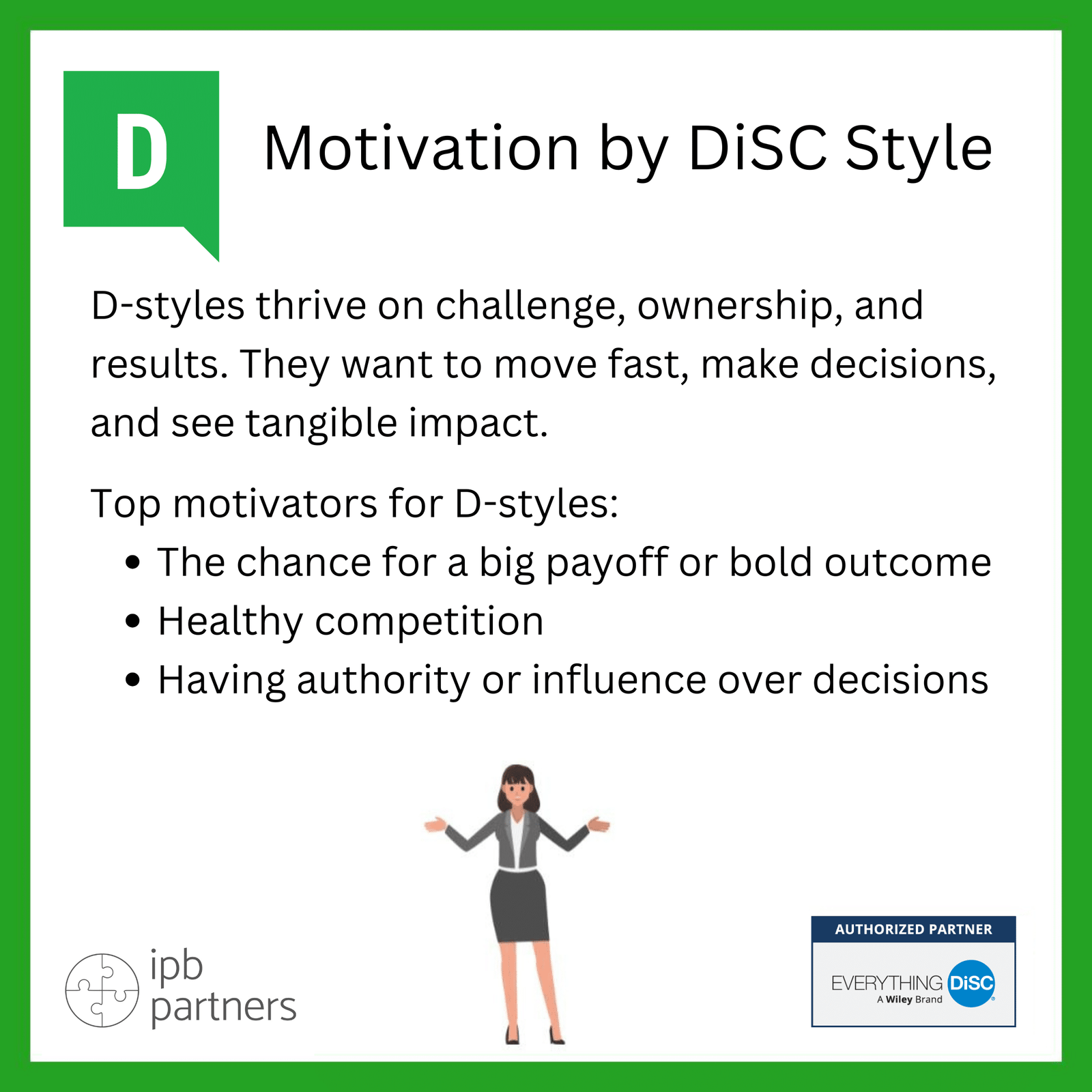
D-styles thrive on challenge, ownership, and results. They want to move fast, make decisions, and see tangible impact.
Top motivators for D-styles:
- The chance for a big payoff or bold outcome
- Healthy competition
- Having authority or influence over decisions
Their core psychological needs are control, progress, autonomy, and avoiding weakness. If you want to engage a D-style team member, focus on goals, impact, and independence. Give them freedom to choose their path—as long as the outcomes are clear.
 i-Style Motivation: Energy, Connection, and Positive Momentum
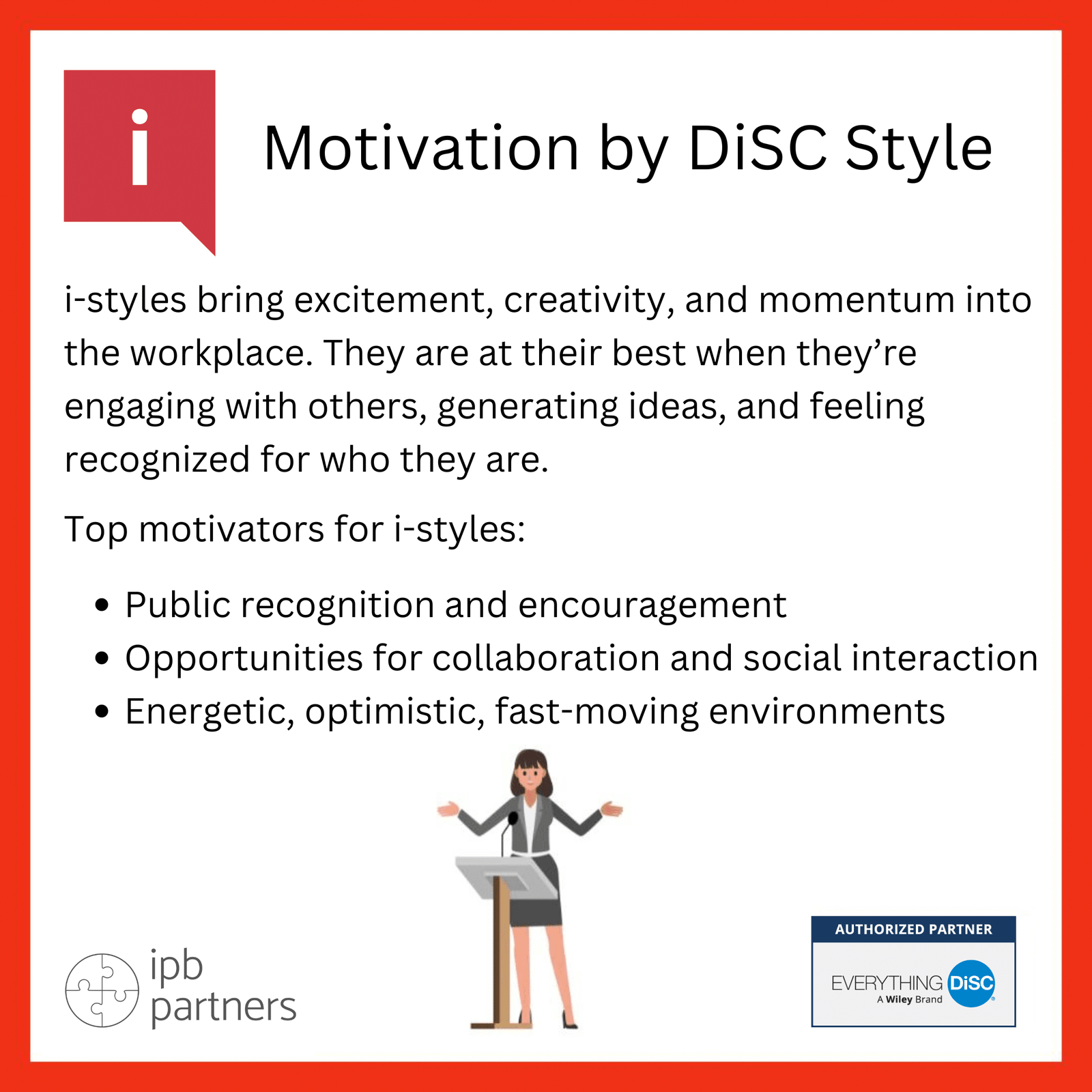
i-styles bring excitement, creativity, and momentum into the workplace. They are at their best when they’re engaging with others, generating ideas, and feeling recognized for who they are.
Top motivators for i-styles:
- Public recognition and encouragement
- Opportunities for collaboration and social interaction
- Energetic, optimistic, fast-moving environments
The Psychological Needs model highlights that i-styles crave expression, social contact, play, optimism, and being heard.
Encourage them to brainstorm, lead group efforts, or champion new initiatives. Their motivation rises quickly when they feel connected and appreciated.
 S-Style Motivation: Stability, Trust, and Purposeful Support
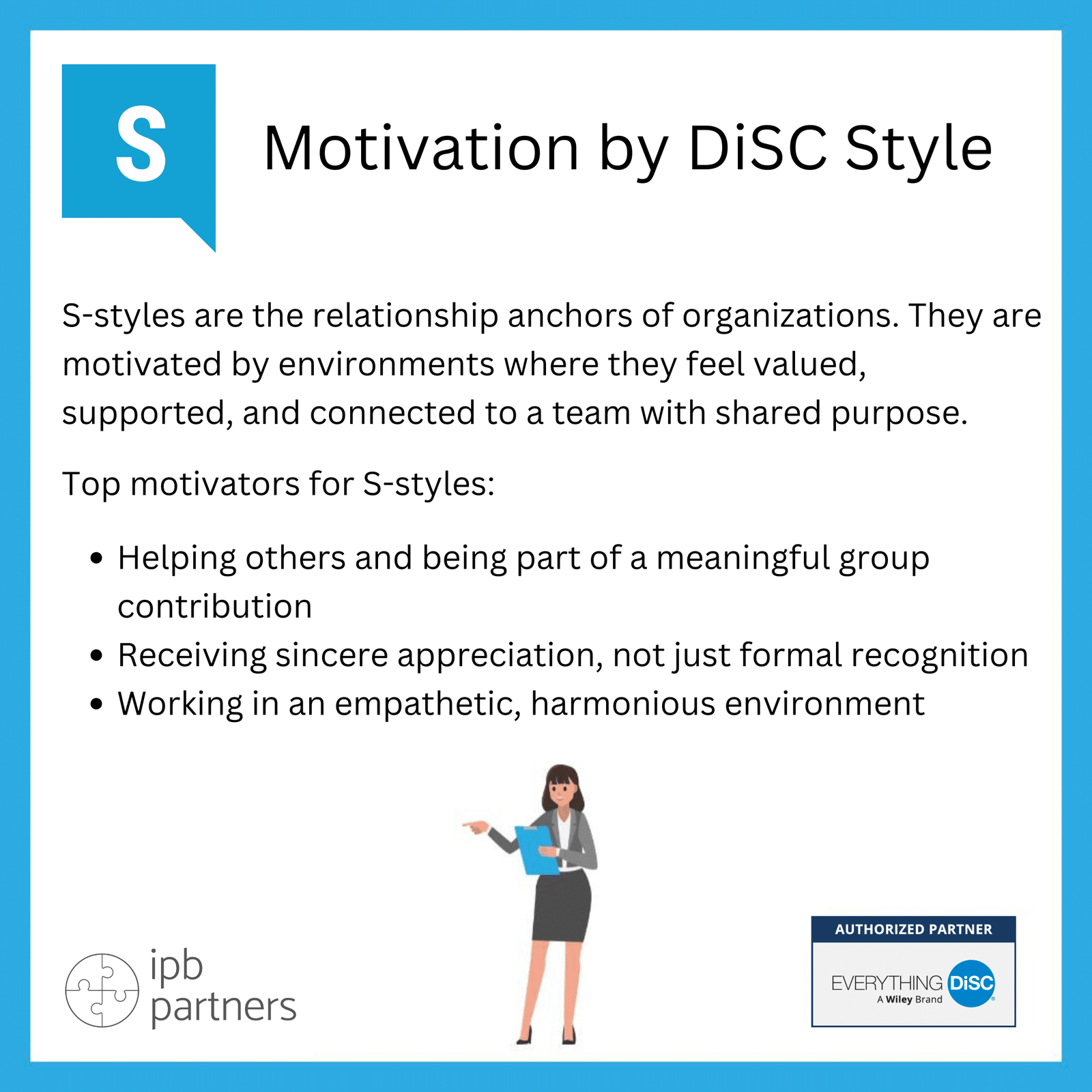
S-styles are the relationship anchors of organizations. They are motivated by environments where they feel valued, supported, and connected to a team with shared purpose.
Top motivators for S-styles:
- Helping others and being part of a meaningful group contribution
- Receiving sincere appreciation, not just formal recognition
- Working in an empathetic, harmonious environment
Their psychological needs include reassurance, nurturance, harmony, and familiarity.
S-styles shine when they know their work matters and their team relationships are strong.
For leaders, this means communicating change early, inviting input, and recognizing supportive behavior—not only visible achievements.
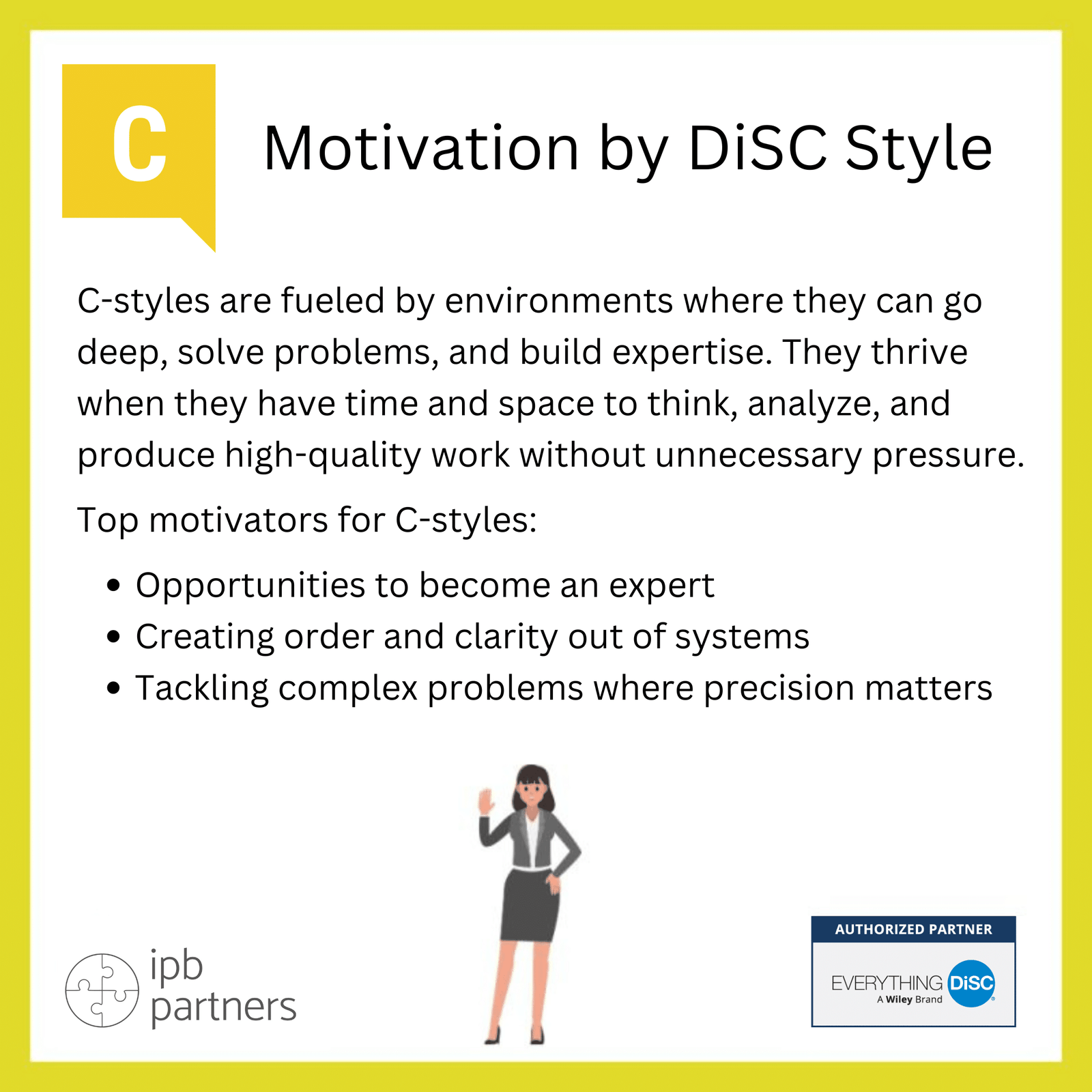 C-Style Motivation: The Drive for Mastery and Accuracy
C-styles are fueled by environments where they can go deep, solve problems, and build expertise. They thrive when they have time and space to think, analyze, and produce high-quality work without unnecessary pressure.
Top motivators for C-styles:
- Opportunities to become an expert
- Creating order and clarity out of systems
- Tackling complex problems where precision matters
These motivators reflect the psychological needs of competence, credibility, and adherence to standards. To engage a C-style employee, provide them with autonomy in structuring their work, access to resources that deepen their knowledge, and clear expectations.
What Demotivates People? The Hidden Triggers Leaders Often Miss
Understanding motivation is only half the picture.
The Demotivators by DiSC Style poster provides a helpful lens to see what drains each style’s energy.
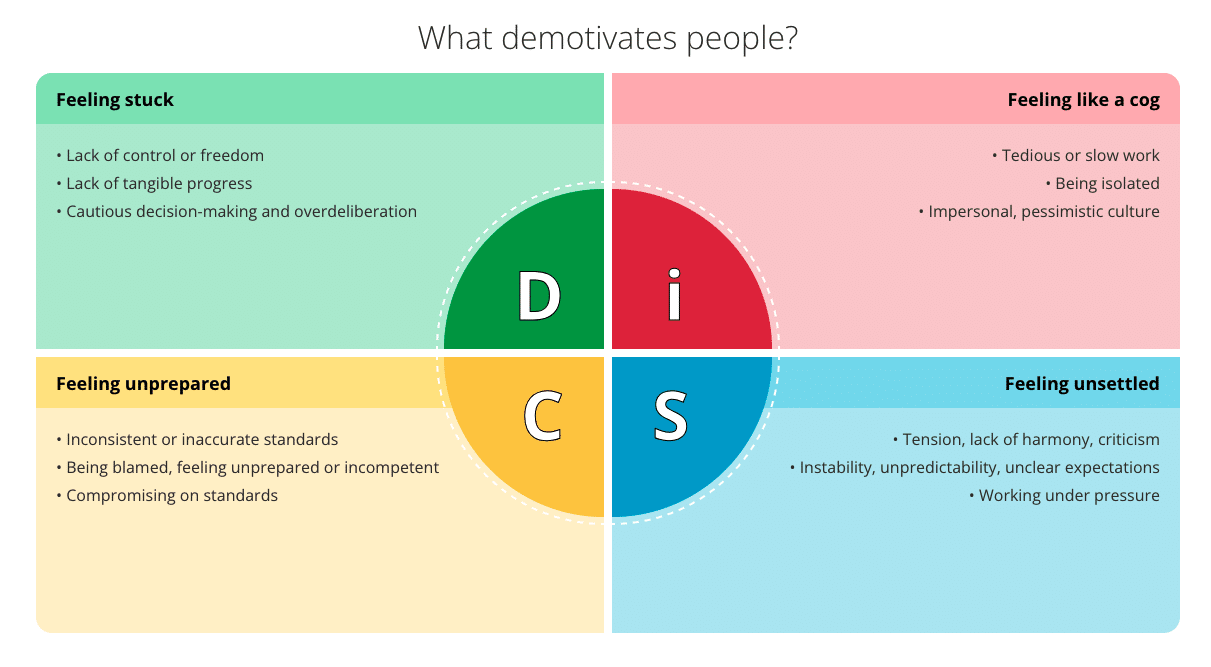
Let’s connect these with the psychological needs.
🟢 D-styles become demotivated when they feel stuck
- Lack of control
- Slow processes
- No visible progress
This violates their needs for autonomy, influence, and challenge.
🔴 i-styles disengage when they feel like a cog in the machine
- Tedious tasks
- Isolation
- Pessimistic or overly formal environments
This conflicts with their needs for expression, optimism, and social contact.
🔵 S-styles shut down when they feel unsettled
- Criticism or tension
- Unpredictability
- High pressure
This disrupts their needs for harmony, stability, and reassurance.
🟡 C-styles withdraw when they feel unprepared
- Inconsistent standards
- Being blamed
- Low-quality processes or unclear expectations
This violates their needs for precision, standards, and competence.
How Leaders Can Use DiSC to Motivate Their Teams More Effectively
Here are five practical ways leaders can leverage these insights:
1. Personalize recognition and rewards
Instead of a generic “great job,” tailor your message:
- D: highlight results and impact
- i: celebrate publicly and enthusiastically
- S: express sincere one-on-one appreciation
- C: recognize accuracy, quality, or depth of work
2. Redesign roles to align with natural strengths
Consider what fuels each style:
- D: autonomy, challenge
- i: collaboration, creativity
- S: support, consistency
- C: analysis, precision
3. Communicate change with style-specific nuance
For example:
- With S-styles, provide advance notice and reassurance
- With C-styles, give details, standards, and rationale
- With D-styles, focus on the opportunity
- With i-styles, emphasize the vision and team energy
4. Reduce demotivators before they cause friction
Use the Demotivators Poster as a diagnostic tool:
- Are D-styles stuck waiting for approvals?
- Are i-styles isolated?
- Are S-styles dealing with constant change?
- Are C-styles forced to compromise on standards?
Eliminating demotivators is often far more powerful than adding perks.
5. Build psychologically safe, need-aware teams
The Psychological Needs model reminds us that people thrive when their deeper needs are respected, not just their behaviors.
Teams perform better when:
- D-styles feel empowered
- i-styles feel connected
- S-styles feel supported
- C-styles feel prepared
This is the foundation of high engagement.
When Leaders Understand Motivation, Everything Changes
Motivation isn’t mysterious — it’s predictable. With DiSC, leaders gain a practical, human-centered toolkit for understanding what energizes each person and what shuts them down.
When managers learn to lead through the lens of motivation:
- communication improves
- team morale strengthens
- performance rises
- conflict decreases
- people feel seen, valued, and empowered
Whether you’re working with ambitious D-styles, enthusiastic i-styles, steady S-styles, or analytical C-styles, the key is the same:
Motivate people the way they need — not the way you prefer.
In a workplace shaped by uncertainty and rapid change, that ability isn’t just helpful, it’s transformational.
You might also be interested in