
In today’s fast-paced and competitive business landscape, the success of an organisation hinges on the strength and effectiveness of its teams. High-performing teams don’t just happen by chance; they are intentionally cultivated and nurtured through shared behaviours and values. One of the most influential frameworks in team development is the New York Times best-seller, The Five Dysfunctions of a Team, introduced by renowned author and organisational consultant Patrick Lencioni. With more than 4 million copies sold and a trusted model, it is the definitive guide for building high-performing teams worldwide.
Here’s a bit about the power of The Five Behaviors®:
The Five Behaviors model offers a comprehensive approach to cultivating teams by building trust, fostering healthy conflict, promoting commitment, ensuring accountability, and achieving collective results. It provides a roadmap for teams to not only achieve their goals but to thrive and excel in their performance.
Are you ready to take your team to new heights? Let’s begin our exploration of The Five Behaviors and discover the transformative power they hold in creating highly cohesive and successful teams. In this blog series, we will dive deep into each of The Five Behaviors, exploring their importance, practical implementation strategies, and the transformative impact they can have on team dynamics. Before we do that, let's take a high-level look at each behaviour and how it can help your teams rise together:
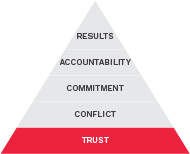
TRUST
The foundational behaviour of a cohesive team is trust. Although many people think of trust as the ability to predict a person’s behaviour based on experience, that’s not what we’re talking about here. Rather, in the context of a cohesive team, trust means a willingness to be completely vulnerable with one another: to let down our guard, admit our flaws, and ask for help.
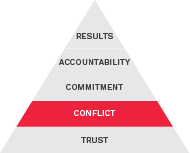
CONFLICT
Conflict is often considered taboo, especially at work, and people may spend inordinate amounts of time and energy trying to avoid the kind of passionate debates that are essential to any great team. However, teams that are willing to engage in productive conflict tend to resolve issues and create the best possible solutions in the shortest period of time.
By productive conflict, we mean debate that’s focused on concepts and ideas but avoids mean-spirited, personal attacks.
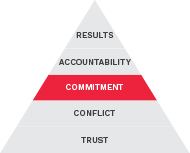
COMMITMENT
If team members don’t commit, they’re just half-heartedly going along with decisions, which means they’re unlikely to have the kind of alignment necessary to reach their goals. In the context of a cohesive team, commitment means having clarity around decisions and moving forward with complete buy-in from every member of the team, even those who initially disagreed with the decision.
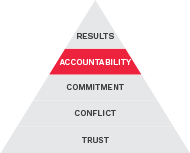
ACCOUNTABILITY
Once everyone on a team is committed to a clear plan of action, they will be more willing to hold one another accountable. In the context of teamwork, accountability is the willingness of team members to call their peers on performance or behaviours that might hurt the team. Accountability can be one of the toughest behaviours to implement on a team because it means overcoming the interpersonal discomfort that accompanies confronting peers about their behaviour. However, with practice and a foundation of trust, having accountability becomes easier and helps teams grow.
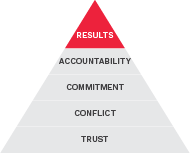
RESULTS
The ultimate goal of encouraging trust, conflict, commitment, and accountability is to achieve results. And yet, as it turns out, one of the greatest challenges to team success is inattention to results. In the context of a cohesive team, results refer to the collective goals of the team; they are not limited to financial measures but are more broadly related to expectations and outcome-based performance.
Whether you are a leader or an individual contributor, understanding and embracing these behaviours will unlock the true potential of your team. We look forward to embarking on a journey through The Five Behaviors, where you will gain invaluable insights, practical tips, and real-world examples that will empower you to foster a culture of cohesion, trust, and excellence within your own team.
This blog content belongs to Everything DiSC®, a Wiley brand.
Ready to work on The Five Behaviors with your own team?